Is a Commercial Nugget Ice Maker Worth It?
A commercial nugget ice maker delivers serious output, but plumbing, ventilation, cleaning, and cost can make countertop models the smarter buy at home.
We may earn money or products from the companies mentioned in this post.
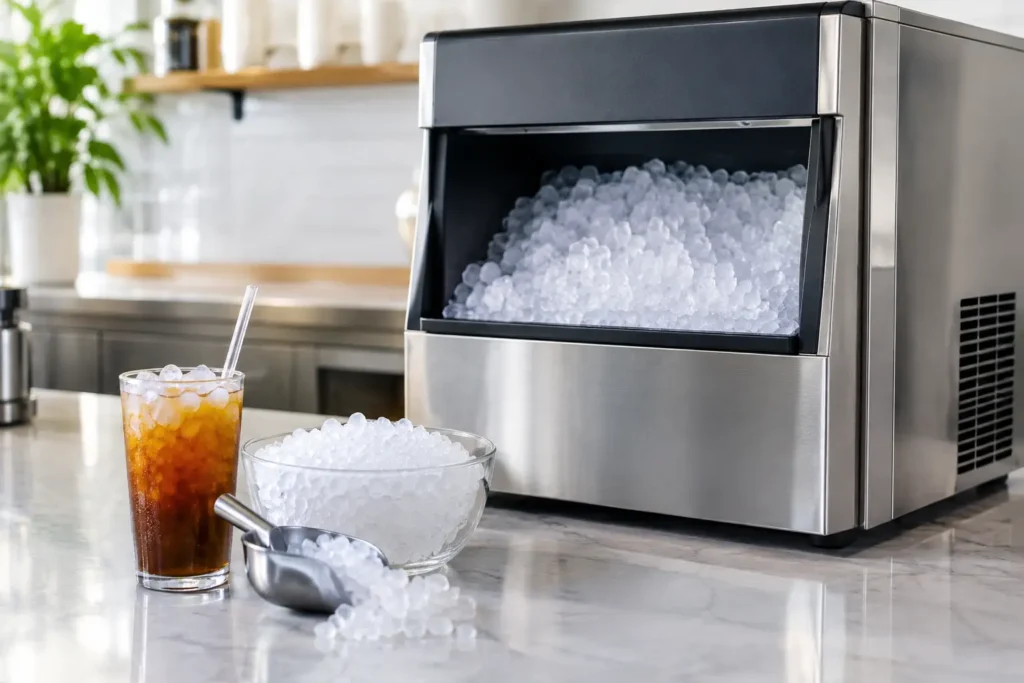
A commercial nugget ice maker can turn a home bar, busy office, or serious entertaining space into the place everyone gravitates toward. The soft, chewable pellets chill drinks quickly, absorb a little flavor, and deliver that familiar Sonic-style crunch. But commercial equipment is not simply a bigger countertop machine. It brings higher output, permanent installation requirements, regular sanitation work, and a price tag that only makes sense for the right buyer.
For most households, a countertop nugget ice maker remains the practical choice. For the household that fills coolers every weekend, runs a home beverage station, or has a large family of dedicated ice chewers, a commercial unit can be the better long-term answer.
What a commercial nugget ice maker does differently
Commercial nugget machines are built for sustained production rather than a few glasses at a time. While many countertop nugget makers produce roughly 25 to 45 pounds of ice per day under ideal conditions, commercial models commonly start around 80 to 100 pounds per day and can run into the several-hundred-pound range.
That headline number matters, but it is not the only difference. Commercial units usually connect directly to a water line, drain continuously, and make ice automatically whenever the bin calls for it. You do not fill a reservoir, wait for a small basket to cycle, or move melting ice back through the machine.
The ice is usually denser and more uniform, too. Quality varies by manufacturer and water conditions, but commercial nugget systems from names such as Scotsman and Hoshizaki are designed to make consistent ice through long service days. That is why they are standard equipment in hospitals, convenience stores, restaurants, and break rooms.
The trade-off is simple: they are appliances, not gadgets. They need room to breathe, proper utility connections, cleaning discipline, and sometimes professional installation.
Commercial nugget ice maker: who should buy one?
A commercial unit is best for buyers who repeatedly outgrow countertop production. If your machine empties during every party, your family uses multiple insulated tumblers a day, or you want a dedicated ice supply for an office, the upgrade can stop the constant scramble for bagged ice.
It also makes sense when convenience matters more than portability. A plumbed machine makes ice while you sleep, work, or host. There is no reservoir to refill and no need to babysit a small bin during a busy afternoon.
That said, “commercial” does not automatically mean “best.” A 100-pound-per-day machine is excessive for a couple who likes one iced coffee and two evening cocktails. It will cost more to buy, use more electricity and water, and demand more care than a countertop model that already meets the real need.
At NuggetLab, we would frame the decision around peak demand, not wishful thinking. Count the people who use ice on your busiest normal day, then account for guests, coolers, and warm-weather weekends. If you regularly need more than 30 to 40 pounds in a day, commercial equipment deserves a closer look.
The installation details that surprise home buyers
The first surprise is that most commercial nugget machines are not plug-and-play. Many need a dedicated potable water line, a floor drain or approved drain connection, and enough electrical capacity for the model. Undercounter installations may also need a drain pump if gravity drainage is not available.
Ventilation is equally important. Air-cooled machines reject heat into the room, so cramming one into a sealed cabinet can hurt output and shorten component life. Water-cooled units avoid some ambient-heat issues, but they can use substantially more water and are rarely the sensible choice for a home.
Then there is physical size. A compact undercounter commercial machine may fit beneath a standard counter, but check depth with hoses, door swing, ventilation clearance, and access for cleaning. Larger modular heads sit on storage bins and can quickly dominate a utility room, garage bar, or basement kitchenette.
Noise deserves an honest mention. Compressor and auger noise is normal with nugget ice production, and commercial machines can be louder than a countertop unit. Placement matters. A laundry room, pantry, basement bar, or insulated utility space is usually a better fit than an open kitchen beside the breakfast table.
Production rate is not storage capacity
Shoppers often see “100 pounds per day” and assume they can store 100 pounds of ice. They cannot. Production rate describes what the machine can make over 24 hours in favorable conditions. Bin capacity is how much ice it can hold at once.
A commercial nugget ice maker with a 100-pound daily rating may have a bin that holds 30 to 50 pounds. Once the bin fills, production pauses. As users scoop ice and the level drops, the machine starts again.
This is still a major advantage over countertop machines, whose bins often hold only 2 to 3 pounds and are not freezers. Commercial bins are insulated, not frozen, so some meltwater is normal there as well. The difference is that the machine is plumbed, drained, and ready to replace ice as it melts or gets used.
For parties, bin size can matter more than daily production. If you want a large ready-to-serve supply at 6 p.m., choose a bin that matches the event rather than relying only on a big production claim.
Cleaning is the price of great nugget ice
Nugget ice machines have more going on internally than a simple tray-style ice maker. Water minerals, scale, airborne dust, and biofilm can affect taste, output, and reliability. Commercial equipment does not escape this reality just because it costs more.
Expect to clean and sanitize the water system on a regular schedule. In many homes, every three to six months is a reasonable baseline, but hard water, heavy use, and visible buildup can mean more frequent cleaning. The bin, scoop, door surfaces, and drain area also need routine attention.
A water filter is one of the smartest add-ons for a plumbed unit. It can reduce scale and sediment, improve ice taste, and make maintenance less punishing. It does not eliminate cleaning, and it needs replacement on schedule.
Before buying, check whether the unit has an accessible cleaning cycle, removable components where appropriate, and clear service documentation. A machine that is difficult to maintain is a machine that eventually makes disappointing ice. This is one area where the lowest purchase price can become expensive.
What you will actually pay
Countertop nugget ice makers generally occupy the few-hundred-dollar range, with premium smart models pushing higher. Commercial nugget equipment starts much higher and can climb quickly once you add a storage bin, filter system, installation labor, drain pump, and extended service coverage.
Operating costs also deserve a place in the budget. Commercial machines use electricity and water continuously enough to maintain supply. Their real-world production falls when the incoming water is warm or the room is hot, so do not size your setup around a perfect laboratory rating.
The value case is strongest when the machine replaces frequent bagged-ice purchases or supports a high-use space every day. It is weaker when the machine will sit idle for most of the week. A high-capacity appliance only earns its counter or utility-room footprint when the ice demand is equally serious.
Better alternatives for most homes
If you want nugget ice for daily drinks but do not need a permanent water line, a premium countertop unit is usually the sweet spot. It costs less, plugs into a standard outlet, travels more easily, and still produces enough ice for a typical household if you stay ahead of demand.
An undercounter residential-style machine can offer a cleaner built-in look, but read the specifications closely. Some are commercial-grade units adapted for homes, while others prioritize compact dimensions over high output. Neither approach is wrong. It depends on whether your priority is all-day production, quieter operation, or a polished kitchen installation.
Smart-connected countertop machines are another useful middle ground. App scheduling will not create commercial volume, but starting ice before you get home can be enough to avoid an empty bin at dinner. For many buyers, that is a better convenience-to-cost ratio than plumbing in a larger machine.
The buying verdict
Buy a commercial nugget ice maker when your ice habit is truly high-volume, you have a practical place to install it, and you are willing to clean it like the food-service appliance it is. Choose a countertop model when you want the chewable-ice experience without plumbing, drainage, major upfront cost, or a standing maintenance appointment.
The best machine is not the one with the biggest pounds-per-day claim. It is the one that keeps your favorite cup full without asking your kitchen, budget, or weekend plans to work around it.
